A diode is a two-terminal electronic component that conducts current much more readily in one direction than the other. Its terminals are the anode (A) and cathode (K). In normal forward conduction, conventional current travels from anode to cathode. That directional behavior is useful in power conversion, lighting and electronic protection circuits.
Reading a diode symbol is a useful first step when following an electrical drawing. The symbol identifies the terminals; the surrounding circuit shows the component's purpose. Toshiba's diode introduction explains the basic device and its applications.
Diode Symbol: Anode, Cathode and Current Direction
The standard diode symbol has an anode side and a cathode side marked by a straight bar. The letter K is commonly used for the cathode in component pin labels. The separate arrow in the illustration below shows conventional forward current from A to K.
Special diode symbols add details to this basic shape. An LED symbol adds outward-pointing light arrows, while a photodiode uses inward-pointing arrows. Zener and Schottky symbols use distinctive cathode-bar shapes. These details identify the diode family.
How Does a Diode Work?
Many common diodes contain a junction between p-type and n-type semiconductor material. A Schottky diode instead uses a metal-semiconductor junction. The junction's behavior changes with the voltage applied across the terminals.
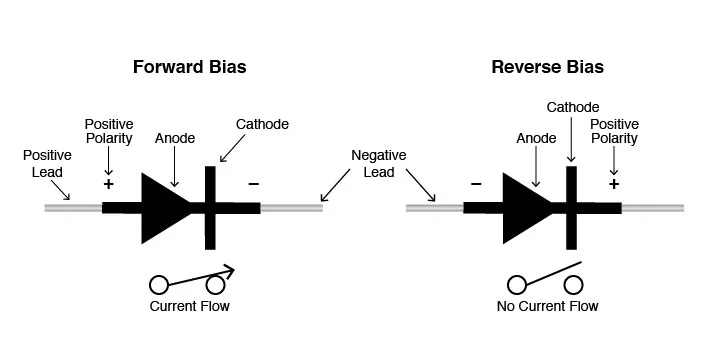
Forward Bias
A diode is forward-biased when the anode is at a higher voltage than the cathode. Forward current increases as the voltage across the junction rises. The diode has a forward voltage drop, so a conducting diode is different from a perfect wire.
Reverse Bias
A diode is reverse-biased when the cathode is at a higher voltage than the anode. Ordinary reverse current is usually small, but real devices have leakage. If reverse voltage reaches the breakdown region, reverse current increases sharply. Zener diodes use a specified reverse-breakdown characteristic as part of their intended operation.
Toshiba's explanation of diode operation shows the bias directions and current-voltage curve.
How to Identify Diode Polarity
On many axial diodes—the cylindrical parts with one lead at each end—a band marks the cathode. For a concrete example, the onsemi 1N4001–1N4007 datasheet identifies its polarity band as the cathode marking.
Match the physical marking to the cathode bar on the schematic. For a surface-mount part, LED or multi-diode package, use the exact component's pin diagram. The anode and cathode names stay the same when the applied voltage reverses; they do not swap with the power-supply polarity.
Common Types of Diodes
- Rectifier diode: Used in AC-to-DC rectification. A rectifier produces a unidirectional, pulsating output; filtering and regulation are separate parts of a power supply.
- Small-signal diode: Used for signal switching, detection and related low-power circuit functions.
- Schottky diode: Silicon Schottky devices are commonly chosen for low forward voltage and fast switching. Forward drop and reverse leakage remain part-specific characteristics.
- Zener diode: Designed to operate at a specified reverse voltage in a suitable circuit, providing a voltage reference or limiting function.
- LED: A light-emitting diode produces light when forward current passes through its junction.
- Photodiode: Produces a light-dependent electrical response and is used in sensing applications.
Fluke's diode overview compares several common families. The family name identifies a general function; the part number identifies the actual device.
Where Diodes Appear in Electrical Circuits
A diode's position in the circuit helps explain its job:
- Rectifier: A single diode or bridge arrangement steers AC into a unidirectional output.
- Series protection: A diode in the supply path can block current when the supply polarity is reversed.
- Voltage limiting: Dedicated Zener or transient-protection devices can limit voltage in the circuits designed around them.
- Relay-coil suppression: A flyback, or freewheeling, diode provides a path for stored inductive energy when a DC coil is switched off.
A relay-coil suppression diode is normally reverse-biased while the coil is energized. Its role changes at switch-off. Texas Instruments explains freewheeling diodes and other inductive-load discharge methods, including their effect on discharge time.
Continue with the electronics and controls references for related components. For the equipment I used in the van, see my camper van electrical system.
Forward Voltage and Other Datasheet Values
A diode's forward voltage is specified at a particular current and temperature. The familiar “0.7 V” silicon example is an approximation, rather than a universal turn-on switch or a fixed voltage drop. Toshiba's electrical-characteristics guide shows why the test conditions belong beside each value.
Keep these fields separate when reading a datasheet:
- Forward voltage (VF): Voltage across the device at the stated forward current and temperature.
- Forward current: An average, continuous or peak current rating, with its applicable conditions.
- Reverse-voltage rating: A limit with a specific definition, such as repetitive peak reverse voltage. It is distinct from a Zener's operating voltage.
- Reverse leakage (IR): Reverse current at the stated reverse voltage and temperature.
- Switching behavior: Recovery time and capacitance describe behavior that a simple one-way-current sketch leaves out.
Diode Questions
Does the stripe on a diode mean positive or negative?
For many axial diodes, the stripe identifies the cathode. “Cathode” is a terminal identity. Whether that terminal is at a higher or lower voltage depends on how the diode is biased.
Can a diode pass current in both directions?
Forward conduction, reverse leakage and reverse breakdown are different operating conditions. A real diode's behavior is described by its current-voltage characteristics, rather than an ideal rule that reverse current is always zero.
Is a diode the same as a resistor?
No. A resistor is commonly described by resistance and Ohm's law. A diode has a strongly directional, nonlinear current-voltage relationship, which is why its orientation matters in a circuit.