Voltage Drop Calculation
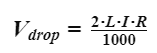
- Vdrop is the voltage drop in volts (V),
- L is the one-way length of the run in feet (ft),
- I is the current in amperes (A),
- R is the resistance of the wire in ohms per thousand feet (Ω/kft).
Ohm'S Law
Defines the relationship between voltage (V), current (I), and resistance (R) in an electrical circuit.
V=I×R
- Voltage (V) is measured in volts (V).
- Current (I) is measured in amperes (A).
- Resistance (R) is measured in ohms (Ω).
Power Equation
- P=V×I
- Power (P) is measured in watts (W).
Relates electrical power (P) with voltage (V) and current (I).
Power In Terms Of Resistance And Current
Derived from Ohm's Law and the Power equation.
- P=I² × R
Power In Terms Of Voltage And Resistance
Also derived from Ohm's Law and the Power equation.
- P=V² x R
Kirchhoff’s Voltage Law (KVL)
States that the sum of all electrical voltages around any closed network is zero.
- ∑V=0
- This principle is used to calculate unknown voltages in a circuit loop.
Kirchhoff’s Current Law (KCL)
States that the total current entering a junction must equal the total current leaving the junction.
- ∑I in = ∑I out
Capacitance And Charge
Describes the relationship between the charge (Q) stored in a capacitor, its capacitance (C), and the voltage (V) across it.
- Q=C×V
- Charge (Q) is measured in coulombs (C).
- Capacitance (C) is measured in farads (F).
Inductive Reactance
Determines the reactance (X_L) offered by an inductor at a certain frequency (f).
- XL = 2 π f L
- XL is measured in ohms (Ω).
- Frequency (f) is measured in hertz (Hz).
- Inductance (L) is measured in henrys (H).