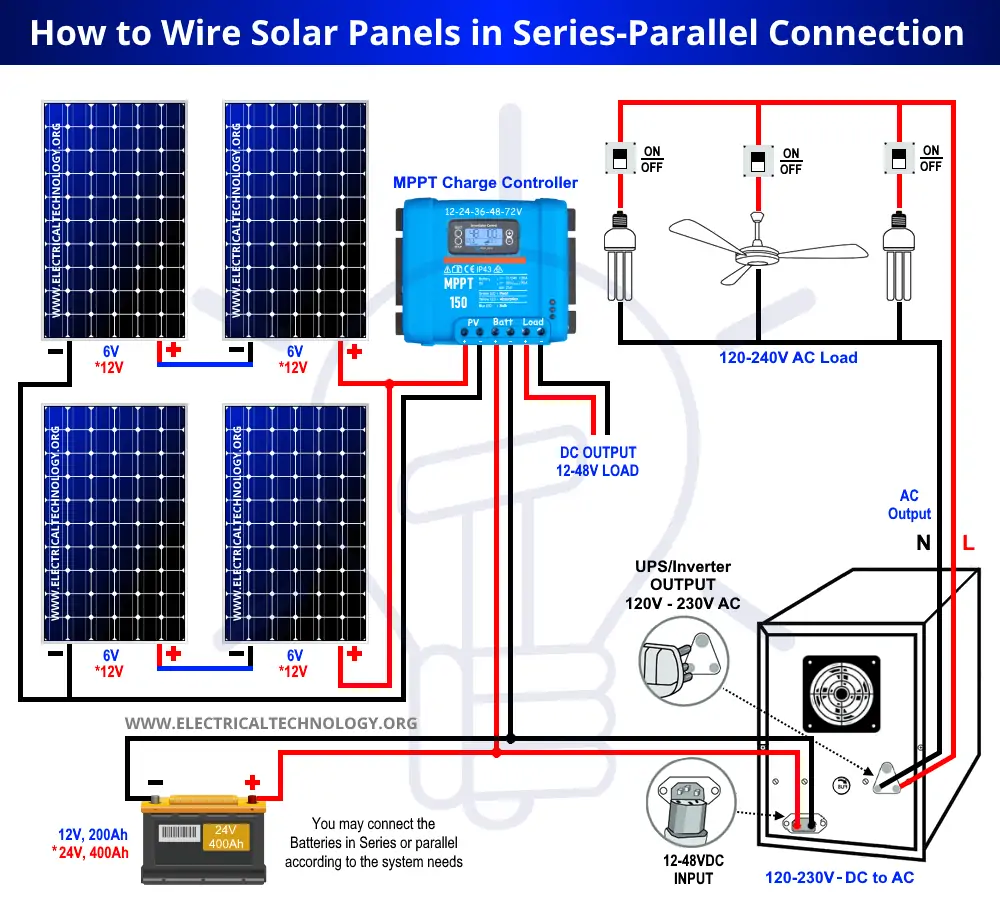
How Series-Parallel Wiring Works
A series-parallel array connects panels into series strings, then joins those strings in parallel. Within a string, panel voltages add. Between matched parallel strings, currents add.
For example, two identical panels operating at 20 V and 5 A form a 40 V, 5 A string. Two equal strings in parallel form a nominal 40 V, 10 A array: 400 W before losses.
Benefits To Evaluate
- Voltage And Current Balance: The layout provides another option between putting every panel in series and putting every panel in parallel.
- Cable Losses: Compared with an all-parallel arrangement of the same panels at the same power, higher voltage and lower shared-cable current can reduce resistive loss for the same cable resistance.
- Controller Compatibility: An appropriate layout may fit a controller’s input range. Compatibility requires checking the exact controller and panel specifications.
Series-parallel wiring does not inherently increase the wattage available from the same panels. Controller efficiency, sunlight, temperature and losses determine the actual result.
Limits And Tradeoffs
- Shading: A shaded panel can constrain its series string while other parallel strings continue contributing.
- Matching: Check panel and string electrical characteristics.
- Expansion: Adding another string raises array current and power. Recheck controller, connector, cable and protection limits before expanding.
- Connections And Protection: More branches introduce additional connection and protection checks. A diagram alone cannot establish the necessary fuse sizes or wire gauges.
Check Voltage In Cold Conditions
Use panel open-circuit voltage and its temperature coefficient to check the highest expected string voltage. Victron’s installation guidance specifically calls for this temperature check. Its numeric limits apply to the controller models covered by that manual; use the manual for your own model. Read The Manufacturer’s PV Array Guidance.
Compare The Other Layouts
The Series Vs. Parallel Comparison shows the same illustrative four-panel array in three layouts. For an individual layout, see Series Wiring or Parallel Wiring.