What the Original Desk Idea Proposes
The archived notes explore reusing an existing sit-stand desk mechanism with a wall-side frame and slider. The intended outcome is a working surface with space underneath. These are concept notes, rather than a record of a completed or tested vehicle installation.
The phrase “float” describes the desired open floor area beneath the desk.
Original Concept Notes.
Automatic Sit/Stand Desk project on Instructables
- Use the Black Sitting/Standing Desk Motor I already have
- Make the bottom of the desk float so there's plenty of room underneath it, removing the requirement of base for the desk to touch the ground.
- Can possibly cut the legs of the black desk and then mount them on a base connected to the 2020 on the wall. That may be an easy shortcut to do this.
- Attach the edges of the desk against the wall to a bearing slider like the one linked above.
Record the Full Motion Envelope
Draw the proposed desk in its intended low and high positions, together with the nearby wall, seat and storage. Include the space occupied by the mechanism and the route needed for its cables. This is a way to identify missing information before treating the desktop outline as the whole assembly.
- Mechanism identity: record the actual make, model and available instructions for the existing unit.
- Travel: use verified dimensions for both end positions and identify any intermediate position that needs a separate clearance check.
- Access: show where controls, fasteners and serviceable parts would remain reachable.
- Interfaces: document how the proposed desktop, slider and frame would meet, leaving unresolved connections clearly marked.
- Vehicle use: record what must be resolved about the assembly’s intended position during travel.
Resolve Compatibility Before Modifying Parts
Keep the motor, slider and frame information together when planning the connection and support arrangement.
Compare the extrusion profile diagrams when identifying the frame. Use the full-size layout mockup checklist for reach and space observations, then record the remaining design questions in the decision log.
Reference guide expanded October 20, 2026. Original publication date and archived references retained.
Product Options
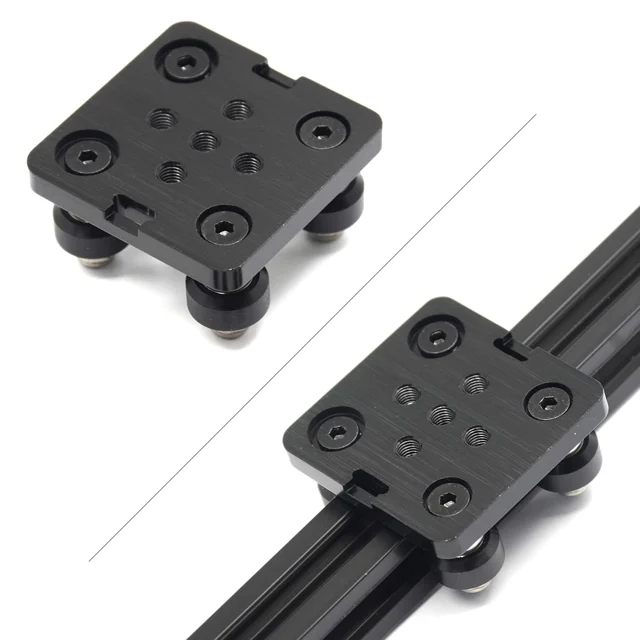
Alternative: Befenybay V-Wheel and Plate
This small V-wheel assembly includes a mounting plate for an aluminum-profile mechanism. The wheel rolls along the profile as part of a guided moving assembly.
View On Amazon: Alternative: Befenybay V-Wheel And PlateWatch: Sit-Stand Desk Motion Planning
My narrated guide follows the desk mechanism, low and high positions, cable route and surrounding clearance.
Press Play To Start The Video.
Read The Video Transcript
Hey, I'm Steve Smith with Camper Van Freedom. My desk notes explore reusing the sit-stand mechanism I already had with a wall-side frame and slider. The idea was to leave open floor space beneath the desktop. To develop that idea, I start with the actual mechanism and its instructions, then draw the moving assembly rather than just a rectangle for the work surface.
Draw the desktop in its intended low and high positions. Put the wall, seat and nearby storage in the same view. Keep each position's dimensions with the mechanism information. If an intermediate position matters for reach or access, record that position too. The space occupied while the desk moves is different from the outline of the desktop at rest.
The desktop is only one part of that moving space. Include the mechanism underneath it, the proposed support arrangement and the cable route. Follow the cables from their fixed connection to the moving part. Show where the route changes as the desktop moves, and keep any missing measurements visible in the working drawing rather than filling them with a guessed number.
Keep the controls and service points reachable in the layout. Mark the intended control location, the fasteners that need access and any covers that would need to come away. Check those locations with the seat and storage drawn in place. A clear work surface does not by itself show whether the mechanism can be inspected or removed later.
Draw the proposed frame, slider and desktop interfaces together. Identify the actual mechanism before planning changes to its legs or other parts. Keep the chosen profile and connection details with that record. The open space beneath the desk is an intended layout result; it does not establish how a particular support arrangement carries the assembly.
Bring that moving desk into the full-size layout check. Record reach, legroom, neighboring storage and the intended position for travel as separate decisions. Save the drawing revision and the observations together so a later change does not lose the earlier questions. Thanks for watching. I'm Steve Smith with Camper Van Freedom. Draw the mechanism, its movement and the space around it as one desk assembly. See you next time.
Watch On YouTube
Watch On YouTube · English Captions (VTT) · Download The Transcript